


Repairing a vehicle saves you the significant upfront expense of replacing it. That sounds particularly attractive in a time of rising vehicle prices and supply chain uncertainty, factors that are already taking a toll on fleet business’ budgets.
However, as a vehicle ages, maintenance needs typically become more frequent and costly. Replacing a vehicle eliminates many of those short-term maintenance concerns and can improve reliability, safety and efficiency — but it’s also the more expensive option.
So what is more cost-effective over the long run?
Every repair-or-replace decision is case-specific, depending on a vehicle’s condition, operating costs, utilisation and remaining useful life. Nowadays, we can see all of that with data.
Modern vehicles are built to last longer — with improved reliability, better diagnostics and lower maintenance requirements — so the safest way to avoid replacing vehicles too early is by making decisions based on real-world numbers from tracking, telematics and diagnostic technologies.
There’s no longer need to rely on intuition or outdated rules of thumb such as arbitrarily replacing vehicles after three years or 60,000 miles. By analysing maintenance history, downtime trends, diagnostic fault codes and total cost of ownership, fleets can determine when a vehicle is still worth repairing. Effective maintenance management is a core part of a fleet’s financial strategy.
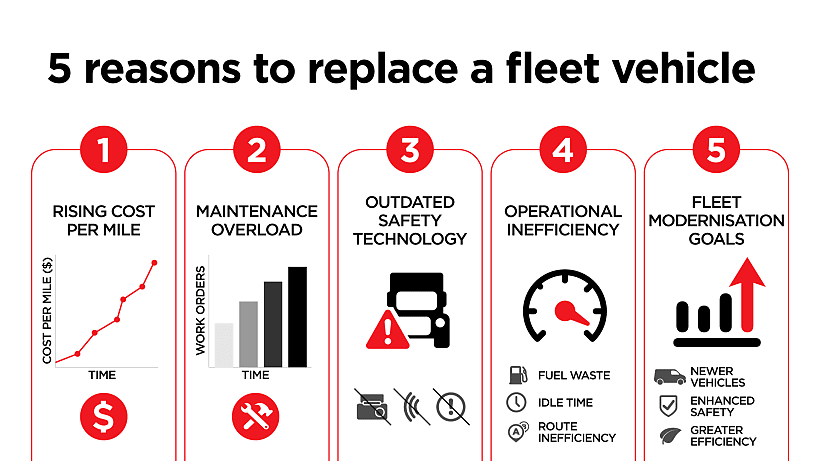
5 concrete signs it’s time to replace your fleet vehicles
- Rising cost per mile (CPM): look out for increases in fuel, maintenance and repairs expenses to flag vehicles before they start costing more to operate than a newer replacement would over time.
- Maintenance overload: if repairs sessions or breakdowns are becoming more than occasional, it’s likely time to retire the vehicle. Frequent maintenance-related downtime will only continue to disrupt operations, reduce productivity and drive up costs. Running regular checks with a vehicle inspection checklist helps you spot these issues before they escalate.
- Outdated safety technology: older vehicles often lack advanced driver assistance systems (ADAS) and other modern safety technologies. Replacing aging vehicles can not only help protect drivers but also reduce the costs accumulated from accidents, claims and insurance premiums.
- Operational inefficiency: if an asset is limiting your operations — due to poor fuel economy, limited payload capacity, reduced range or an inability to meet business needs — it may be time to acquire another asset that does perform at full potential.
- Fleet modernisation goals/evolving business needs: if you’re looking to align your fleet with changing business priorities, sustainability targets or regulatory requirements, vehicle replacement cycles offer a natural opportunity to update your fleet composition. Introducing electric vehicles can help reduce fuel costs, lower emissions and support long-term environmental goals.
Repair vs. replace: practical examples of fleet lifecycle management
Here are some example scenarios to help you judge when it makes sense to repair a fleet vehicle and when replacement may be the better option productivity- and budget-wise. While every fleet is different, these situations demonstrate the value of using data to guide decision-making.
| Scenario | Recommended decision | Reasoning |
| Vehicle is more than 5 years old or has exceeded 100,000 miles, but maintenance costs remain stable | Monitor and repair | Age alone isn’t a reason for replacement. Continue tracking cost per mile, downtime and reliability trends to identify when the vehicle starts to become a liability. |
| Cost per mile is consistently increasing year over year | Evaluate replacement | Rising operating costs may indicate the vehicle is becoming more expensive to own than a newer asset. |
| A major repair exceeds 50% of the vehicle’s market value | Replace | Investing heavily in an aging asset often delivers poor long-term return. |
| Vehicle experiences frequent unplanned downtime | Replace | Lost productivity, service disruptions and rental costs can quickly outweigh replacement costs. |
| Vehicle no longer meets operational requirements (payload, range, fuel efficiency, etc.) | Replace | Fleet assets should match current business needs and operating conditions, both to stay efficient and avoid regulatory sanctions. |
| Projected maintenance and operating costs remain lower than replacement costs over the next 2–3 years | Repair | Data supports maximising the asset’s remaining useful life. |
What are the risks of replacing too early or too late?
Fleet vehicle lifecycle management requires careful planning to avoid unnecessary spending, downtime and low return on invesment. Modern fleet vehicles are engineered to perform reliably for much longer than traditional replacement benchmarks, so retiring them before they’ve reached the end of their economically useful life is value wasted.
It can also eat into budget that could be better invested elsewhere.
Replacing vehicles too late is equally problematic. Aging assets typically experience more frequent breakdowns, higher maintenance expenses and increased downtime, all of which can lead to lost business. Older vehicles may also lack modern safety features and fuel-efficient technologies, increasing both operational risk and total cost of ownership. Holding onto them for too long can lead to excessive spending on assets that continue to demand more while delivering less.
The challenge for fleet managers is finding the balance: replacing vehicles before costs begin to accelerate, but not so early that they sacrifice years of productive service.
How do depreciation and maintenance costs affect replacement decisions?
Depreciation, a silent drain on asset value, is largely outside of a fleet manager’s control. From the moment a vehicle enters service, its value begins to decline due to age, mileage, market conditions and demand for used vehicles. New vehicles lose 20-25% of their value in the first year and up to 60% by year five.
The best approach is to monitor depreciation alongside operating and maintenance costs so replacement decisions are based on the vehicle’s total financial impact rather than any single metric.
What is the ideal replacement cycle for company cars or commercial vehicles?
There is no universal replacement cycle that works for every fleet. To find the sweet spot for a particular vehicle, you need access data on its operating life, including cost per mile, maintenance spend, downtime, fuel consumption and resale value, and then use that information to forecast future costs.
With these insights, you can identify the point where the depreciation curve begins to level off, but before maintenance, repair and fuel costs start rising sharply. This is typically the replacement window that delivers the lowest total cost of ownership.
How to calculate or determine a vehicle replacement timeline?
Fleet managers can calculate a rough expected residual value by applying an annual depreciation rate to its current value.
Residual value = purchase price × (1 − annual depreciation rate)^years old
For example, if a vehicle was purchased for €40,000 and is expected to depreciate by 15% per year:
After 1 year: €40,000 × 0.85 = €34,000
After 2 years: €40,000 × 0.85² = €28,900
Fleet managers can compare the resale value with the projected operating cost savings of replacing the vehicle to decide whether it is worth investing in a new asset.
Strategic planning: aligning replacement with long-term goals
Changing fleet composition to include more EVs can have many benefits, including lower fuel and maintenance costs, reduced emissions and greater compliance with evolving environmental regulations. But replacing large chunks of your fleet at once represents a significant upfront investment during a single budget cycle, as well as substantial downtime, coordination challenges and a potentially steep management learning curve.
Fleet managers can proceed with greater certainty by using vehicle lifecycles to set the pace for a gradual EV transition and spread expenditure across multiple fiscal years. Companies can align EV purchases with scheduled replacement plans, making the changes more financially manageable. Following vehicle lifecycles also leaves more time for evaluating vehicle suitability across different use cases and reduces the risk of prematurely retiring assets that have useful life remaining.
Building your fleet replacement tracker
Keep track of the vehicles that are becoming less reliable and more expensive by using telematics data to build a downtime dashboard. By monitoring key indicators such as vehicle downtime, repair frequency, maintenance costs, fault codes and cost per mile, fleet managers can spot underperforming vehicles before they significantly affect productivity and profitability.
It’s also a good practice to review residual values annually. This helps fleet managers anticipate replacement needs and invest in new assets before the costs created by an aging vehicle exceed the cost of replacing it.
 South Africa
 Chile
Chile Colombia
 México
 United States
 Australia
 New Zealand
 United Arab Emirates
 Belgique (Français)
 Česká Republika
 Danmark
 Deutschland
 España
 France
 Hungary
 Ireland
 Italia
 Nederland
 Österreich
 Polska
 Portugal
 Schweiz (Deutsch)
 Sverige
 United Kingdom